OncWonk Evidence Nexus – The Next Generation Naturopathic Oncology AI
I have PubMed, OpenEvidence etc. Why should I use OWEN?
GIGO – Garbage In, Garbage Out. – George Fuechsel, IBM 1958
The validity of any clinical synthesis is strictly bounded by the quality of what enters the system. In computational medicine, input hygiene requires two non-negotiable conditions:
- The system must have immediate access to the necessary empirical data.
- The system must systematically exclude distracting, irrelevant, or biased noise.
Today’s clinical AI landscape divides into three prevailing architectures—each introducing a distinct failure mode—before arriving at a purpose-built domain solution:
1. General-Purpose LLMs (Parametric Memory)
Examples: ChatGPT, Claude, Grok
- The Input: An undifferentiated web scrape—Reddit, news commentary, Wikipedia, textbooks, PubMed abstracts, and social media.
- The Failure Mode: Confabulation from Compressed Weights.
When queried on an integrative oncology topic (e.g., curcumin in triple-negative breast cancer), the model does not consult a database. It generates output by recalling statistical patterns compressed into billions of training weights—mathematical approximations of language, not actual studies. - The Clinical Breakdown:
- Cannot identify the specific trial it is drawing from or verify publication dates.
- Cannot reliably distinguish an in vitro cell-line observation from a Phase III human trial.
- Has no architectural mechanism to report that data is insufficient; its loss function forces it to generate a plausible-sounding answer whether evidence exists or not.
- The Result: Confident, fluent fabrication.
2. Open-Web RAG (SEO-Polluted Retrieval)
Examples: Perplexity, Copilot
- The Input: Live indexing of the public internet.
- The Failure Mode: Commercial Noise & The Illusion of Sourcing.
These systems attempt to solve confabulation by retrieving live web pages to ground the model. In integrative medicine, however, the open web is dominated by commercial incentives. - The Clinical Breakdown:
- Retrieval algorithms rank by search authority and SEO optimization, not methodological rigor.
- The AI synthesizes supplement manufacturer whitepapers, clinic marketing blogs, and predatory open-access journals alongside legitimate clinical trials.
- Reassuring superscript citations create the illusion of academic rigor, but citing a high-ranking lifestyle blog or commercial product monograph does not constitute peer review.
- The Result: Unvetted commercial marketing presented with academic formatting.
3. Enterprise Medical LLMs (Broad-Corpus Biomedical RAG)
Examples: OpenEvidence, Large PubMed-Wide RAG
- The Input: A massive biomedical corpus (35–40 million PubMed papers across all medical specialties).
- The Failure Mode: Semantic Dilution & Programmed Skepticism.
These tools represent a genuine advance for conventional medicine, but they fail specialized integrative disciplines through two structural pinch points: - The Clinical Breakdown:
- Cross-Domain Semantic Interference: Ranking algorithms prioritize high-frequency, heavily cited pharmaceutical trials. An integrative query is swamped by conventional protocols that only mention the search terms tangentially. The AI’s finite context window is consumed by general oncology trials, physically displacing the specific botanical studies the clinician needs.
- Hardcoded Institutional Guardrails: Enterprise medical AIs are governed by safety prompts calibrated strictly to conventional guidelines (NCCN, ASCO, FDA). Even when a rigorous botanical study is retrieved, the model is engineered to append preemptive dismissals citing a “lack of standard evidence,” allowing algorithmic gatekeeping to override empirical literature.
- The Result: Literature dilution and structural skepticism.
4. The OWEN Paradigm: Bounded-Domain RAG
Purpose-built for Integrative & Naturopathic Oncology
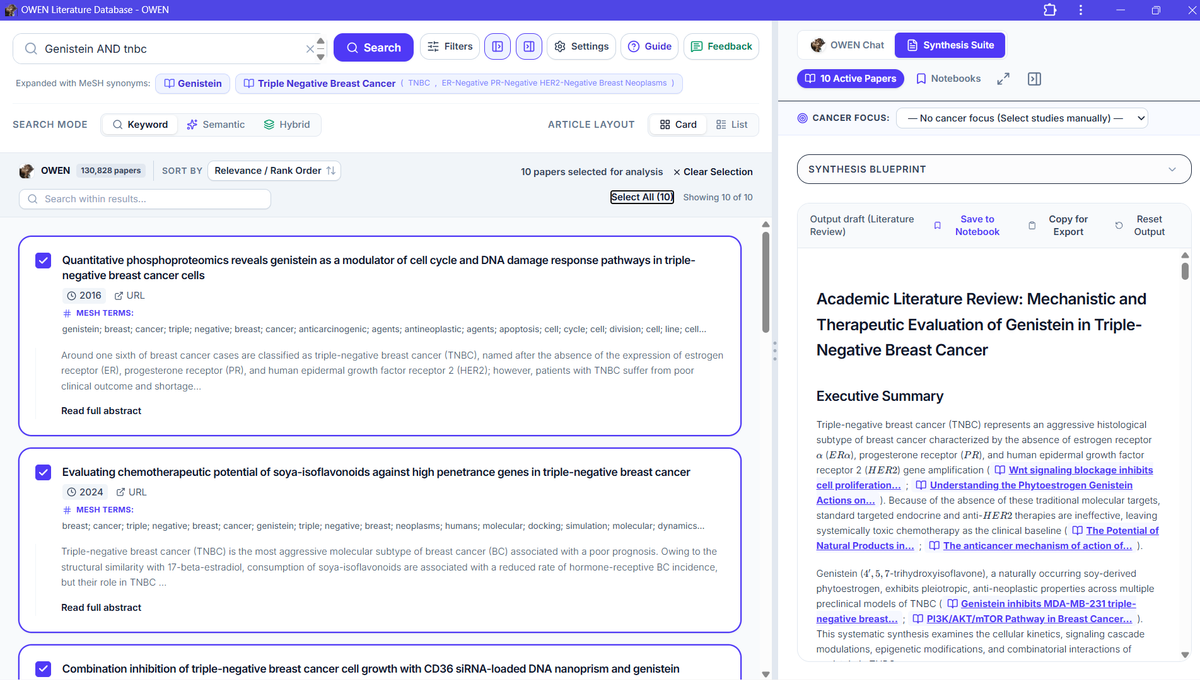
OWEN resolves these issues by restricting its vector space exclusively to an audited library of ~124,000 peer-reviewed integrative oncology papers:
- Corpus Purity: Eliminates cross-domain noise entirely. The retrieval space contains no cardiology, orthopedic, or irrelevant clinical trials—the signal is the corpus.
- Tri-Layer Retrieval: Combines sub-millisecond local keyword matching (BM25), 1536-dimensional semantic vector embeddings, and live MeSH/botanical synonym expansion to surface exact phytochemical and mechanistic endpoints.
- Methodological Hierarchy: Enforces an objective evidence hierarchy (systematic reviews → human clinical trials → animal models → in vitro studies), linking every claim directly to the first words of the source study’s title for instant auditability.
The Architectural Trade-Off (Curation Dependency):
Intellectual honesty requires acknowledging OWEN’s primary limitation. A bounded corpus intentionally trades the real-time breadth of the open web for verified evidentiary precision. OWEN is dependent on continuous, rigorous database curation. If a landmark Phase II botanical trial is published this week but has not yet undergone the ingestion and vectorization pipeline into the database, OWEN will return a null intersection rather than an unvetted guess. It prioritizes evidentiary fidelity over real-time immediacy.
OncWonk Database – The most extensive and comprehensive source for Naturopathic Oncology
Updated through 2025, the database contains 124,000 carefully curated articles related to Naturopathic Oncology.
To update the studies in the database, I run close to 1,000 individual searches. Yes , that’s not a typo.
Why?
-Because the literature on oncology is scattered across multiple MeSH terms. Searching cancer gets only a fraction of those. To get a full(er) view there are 7 distinct terms that have to be searched.
-Because many of our medicines have multiple MeSH terms – curcumin and green tea extract both have 7. The average is about 3.
There are just over 100 components tracked in the OncWonk database. So 100 components with a average of 3 required synonym searches across 7 different cancer terms….
Fortunately I can consolidate a few with Boolean AND statements.
And then I have to run more internal database searches to clean it up. To get the research on chemotherapy I have to run searches that also give articles on drug treatment of malaria, etc. Keeping those in would lead to higher rates of inappropriate responses. No matter how good a LLM is, it will always suffer from dilution effects – the more data there is unrelated to the query, the more likely it is to make a mistake. Multiply that potential across the 40 million to 200 million articles in the top medical/scientific AI, and you can understand why Naturopathic Oncology needs it’s own tool.
For a list of included components, see here.